

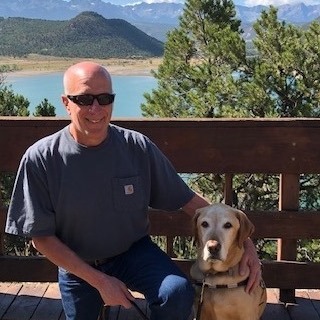
Meet Terence L. Anderson, published author, patented inventor.
From blindness came Kirby, my first seeing eye dog, his life cut short by lymphoma. Loyal and courageous, he was tough beyond belief, working up to the last day of his life. Kirby never quit, and he never once whimpered. The incredible nature of our bond gave me the stories I would write, finally leading me from the darkness.
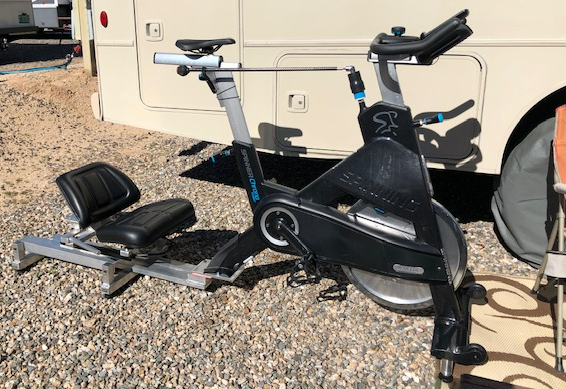
My invention, The Recumbent Exercise Bicycle Attachment, arose more simply, maintaining strength in worn-out knees a common problem. Creating this device was necessary, but it’s writing that consumes me.
‘Dog Talk’ may not be what you think. Keep reading, you’ll see, and I hope you like it. Available on Amazon, along with the sequel, ‘Different Shades of Hardness.’. Book three is underway, yet untitled. Trusting premonition, Dave, Ezra, and the crew hunt like the leopard, careful and deadly, stalking their prey.
Excerpts
Chapter 1, New York, Monday morning
Ben was a partner in Bordeaux Kennels, and Ezra was a gamble. The twenty-one-month-old German Shepherd one-quarter wolf puppy was the first of his kind produced by Bordeaux for guiding. He was the smartest dog Ben had ever seen. Ezra, by breeding, had the size and, to an extent, the mentality and instincts of a wolf.
The partners spoke weekly, Ben’s voice conveying more than the words, his English terrible. “Walt, Ezra, different. He like what you expect when you breed, but I tell you, this dog worries me a little. The dog needs big strong guy, but guy need be very tough, maybe little bit nasty.”
Walt sighed before he spoke, sadness in his voice. “Dave Henry called me two days ago. I know the man, a civil engineer. He’ll be perfect.”
“You mean guy who sit on ass all day at desk and do numbers?”
Walt’s sadness lightened a little. “Well,” he replied slowly, “he also does numbers.
Ben Simon, an Israeli, had come to the United States thirteen years ago, impeccably trained through service in the Oketz Unit of the Israeli Defense Force.
Ezra’s low growl earned the animal a sharp “No,” but a hundred yards away, Ben saw the problem. He knew he should have returned Ezra to the van and come back alone. Instead, Ben dropped the harness handle. “Ezzy, heel, we go.”
Ezra showed no outward signs of aggression, but Ben sensed the animal’s rage. Ezra had hardened, yellow eyes staring through the fence, eyes not his own, eyes from something else. In a serious dog attack, the man’s size meant nothing. Ben knew Ezra could maim or kill him in seconds. He wouldn’t allow that unless things went bad, as they did in Gaza nearly every fucking time. The Israeli surveyed what could become a battlefield. He nodded. “Today, I see how Ezra fights.”
Ezra’s snarl cracked through the hot sticky air, deep, guttural, tailing off in the sound of attack. Menace splattered the man like molten pitch.
Chapter 2, Denver, one year later, Thursday morning, early
Dave Henry appeared normal, though he did stand out. Rangy, with easily twice the strength that would run with a man his size, his face held a peculiar hardness, once enhanced by the intelligence contained in his probing blue eyes.
Blindness wasn’t much of a friend, but hating it only increased the pain. It always wanted more, but he trusted its certainty, the consequences of ignoring its requirements immediate and unpleasant.
Seeing with a cane is an unnatural act. Humbling and immensely difficult, it epitomized the human terror of blindness. Early on, when the pain became unbearable, he had told it to piss up a rope and gone out with his cane.
He frowned as something else cold gnawed from the fringes. He had found that since blindness, anxious feelings often seemed to have no source, which could tend to distort them. He realized diminished cognition was the usual cause, but this sensation seemed different, like an arthritic ache from a phantom bone. It went straight to that part of his nature where the fierceness lived. In addition to being blind, Dave Henry knew he was anything but normal and drifting further.
Chapter 3, Thursday morning
Over the past six months, Dave’s perception of human intentions had heightened. What troubled him was not this awareness but the depth and clarity of these cognitions.
Dave started digging. Canine-human interaction was a warren, a common labyrinth of psychological and emotional roots. Extending back in human existence long preceding canine domestication, it nurtured both species.
Their interaction far exceeded what normally stemmed from qualities intrinsic in a seeing-eye dog. The animal’s perceptions found their way into Dave’s mind, becoming his own, sometimes leaving him edgy, disturbed by things he couldn’t grasp.
Seeing eye dogs must be highly intelligent, emotionally tough, and steadfast in their work ethic, qualities imperative for making the many decisions that are constantly required of them when they work.
Everything changed for the Henry family: Dave, his wife, and his young daughter. Life went on as it does. The change took root like ancient pods cracking glacial ice, and then change took hold.
Chapter 4, Thursday morning
Dave heard the metallic rattle of Marv’s diesel van driving off, telling him to get out of the chair and move. He didn’t, allowing his mind to return to the dreams. The last two nights, he had seen children, probably Susan’s friends, but he wasn’t sure: caricatures, puppets without strings with distorted faces. Another face floated amongst the children, appearing and vanishing, a matronly but pretty woman, except when her skin seemed to melt. He never got a very long look. Engulfed in moving shadow, she could have been fifty, or she could have been dead. This morning the dream had roused him at four-thirty, soaked in sweat. The pretty face had become a head on the catalog page, looking like something that would end up on the front porch in a box.
Dave liked the walk to the store but hated the shopping, even though he was good at it. He appreciated how easy Ezra made it, especially compared to using a cane, and enjoyed the many compliments the animal got every time they went out.
It was no wonder, and even the vet didn’t understand Ezra’s size. Standing thirty inches at the shoulder, Ezra weighed one hundred twenty-nine pounds, dense and lean, much heavier than he should have been. Rangy, solid black with a bushy tail, his wide-set yellow eyes made him appear wise or frightening, depending on his mood. His head was large, with a wide muzzle and distinctive rounded ears. He had large paws and moved with the grace of a wild animal.
Chapter 5, Thursday afternoon
He tried to relax in the checkout line, but when Ezra snarled at the man ahead of them, his stomach wrenched. Dave had seldom heard the dog bark, much less growl, and the sound of it actually scared him. The snarl was loud, guttural, and violent, promising immediate consequences if ignored.
Ezra was still, though the dog’s anger resonated through the harness. Dave sensed people moving away, except the man who had pissed the animal off and who was now screaming.
“You keep that vicious son of a bitch away from me.”
An alcohol-laced wave of bad breath washed over Dave like a hot wet wind from the dump. His gaze said more than the low hard sound of His voice. “You hurt someone. Your best alternative is to shut your mouth and sit on the floor.” Ezra made no sound, Dave said nothing else, and the man sat.
Chapter 6, Thursday late afternoon
Blind Square told Dave the house was east of Downing, about five blocks from their home.
The smell hit him first, some kind of mess left to rot, so putrid Dave tried not to breathe. Then came the cries, an infant’s shrieks of terror, tailing off to pitiful wails that went on and on. Sweat chilled his skin, clammy fingers grasping from air grown cold. The fingers became iron and probed his brain, stealing control. Finally came the image, flooding his mind and slamming him to his knees, sick and groping for his dog. It was the woman from his dream. Mutilated eyes stared upwards, nothing but bloody orbs. Moving lids and pleading lips gave signs to the life beneath. The head sat atop the body of an infant, little legs wrapped in a filthy blanket, hopelessly tangled and kicking. Her tiny arms flailed. A diaper slipped down as the infant struggled, helped by the weight of brown goo that covered her belly. The wails weakened and abruptly stopped as the vision faded. Only the smell of the diaper lingered around him, along with a palpable sense of another presence.
Chapter 7, Six months earlier
Both were Marines; both had seen intense fighting and carried the memories. Neither had eyes, and along with her eyes, Amy had lost part of her nose.
After they sat, Dave introduced himself. He had expected the guarded, offhand way they discussed their injuries but not the extent of their trauma.
Dave felt the gaze of others in the lobby, their sadness momentarily lifted by what they were seeing, but he mostly sensed the animal’s power through the change in the soldiers beside him. He became lost in the interaction, bombarded by questions that came too fast to answer and exclamations of what the two found as they touched his dog.
Even beyond what he heard, it seemed to him as if all the horror calcified within these two was crumbling away, taking the numbness with it. Ezra encouraged these Marines, made children again in return for their courage, to hold him, feel the rough thickness of his coat, the size of his head, and the softness of his muzzle. The contact was an act of healing, providing the beginnings of strength that would sustain both going forward.
Chapter 13, Friday morning, very early
Exhaustion clung to Dave with jagged little claws, making his body ache. Shredding his thoughts, they found dreams of the woman. Dave reached from the clawing in his head and found the screen lock button on his phone. Samantha’s voice told him it was two a.m., lulling him past the clawing to a place where the dreams became real.
He couldn’t move other than breathe. The woman lay naked in the living room of the vacant house, wired to three heavy eye bolts screwed through the carpet to the framing beneath it. Two held heavy legs spread wide, and the other held her arms, stretched past her head, pressed together by the wire that encircled her wrists. She shook uncontrollably from the early morning cold and the terror. A gray rubber sheet lay beneath her, neatly placed, ankle to armpit. Dave heard her whimpers and the sobs that followed, smelling her fear, pungent in the stale air of the empty house. He heard slow footfalls and the woman’s screams. The contortions of her face brought darkness.
Dave emerged from the dark, still trapped in the nightmare of her life. Her wrists and ankles bled, torn by the wire. Her public thatch was matted with blood, her vaginal opening clearly the source. Her breasts, though intact, were lumpy with splotchy swelling, but it was the frantic movement of her head, her moaning, and the twitching of her flesh that consumed him. Eyes slit the length of their sockets, dripping blood and jelly that covered her cheeks. Pleading through the pain, she kept saying something that sounded like “Please” over and over and over, her voice reduced to the cry of an infant. Dave watched her fate play itself out, floating above her, sensing it, knowing death. The coppery smell of blood mixed with the odors of a body shutting down. The putrid breath of a corpse creature brushed his face.
Ruben trembled with eagerness but again waited, ready to flee. He set himself and vaulted cleanly through the opening. He landed three feet inside the bedroom, greeted by the faint scent of a dog.
Ezra exploded from where he waited, driven by fury pent up for days and the instinct that flowed with his blood. Using the force of his charge, he seized the gun hand wrist and crushed it. Driving downward and rolling his head in one vicious motion, he slammed the man face-first to the floor. Instead of killing, he chewed the man’s remaining hand to a pulp, severing the thumb. He backed away from the thumbless hand to the edge of the open door and waited.
Ruben lost control of his bowels and bladder midway through the animal’s snarl, firing the pistol into the floor as he turned. Stunned and helpless, he entered the land of the deaf. Life as he knew it ended. As the animal crushed his wrist, Ruben felt the scream in his throat more than he heard it, stunned by the concussion of the shot that seemed one with the blow to his head. He watched numbly as the attack went on, choking off his second scream in a gurgle. For long moments the Mexican lay limp, dazed by the speed and violence of the attack. He moved his right arm and screamed again, the sound drowning out the ringing in his ears. The pain forced him to turn his head and look. Bloody bone stuck out at the end of his arm, dragging the hand behind like a dead bird. With an effort, he turned his head, closing his eyes. When they opened, he stared at a bloody bag of bone fragments with no thumb, fingers protruding like broken sticks. Ruben sobbed and pressed his face to the carpet.
Ezra watched with the patience of a glacier, making sure.
Chapter 14, Friday morning
The roar of a gunshot jolted Dave awake, tearing him from the dream back into blackness, but the woman’s image clung. She stared up at him with ruined eyes, pleading for release from her nightmare. Dryness hurt his throat, and the sweet bloody taste in his mouth made him wretch. Ezra snouted his ear. Finding the animal’s muzzle, he realized he could move. His fingers were sticky, smelling bloody, and Ezra licked them clean.
The warm wetness of Ezra’s tongue and the smell of gunpowder cleared his mind. The sounds of moaning from the hallway made Dave move.
He stepped back, turning for his room, repulsed by moans and the smell of excrement. Reality became one with his dream, unbound from the restraints of time. He hurried, pulled on a fleece, harnessed Ezra, and heeled the animal outside.
“This is 911; what is your emergency?”
“There’s an intruder in my home. I need police and an ambulance.”
A firm male voice interrupted, “Spears, Lassen; it’s Lieutenant Harris.” Before either could respond, Harris spoke again. “Christ, that dog’s got blood all over its snout.
“Wait, Lieutenant; there’s more. A great deal more.”
Chapter 17, Friday morning
Harris sat back in his chair, and when Dave didn’t continue, he did. His voice invited disclosure. Harris was good at this, in fact, world-class. “You’ve been thinking about this for a long time,” a statement, not a question.
“Yes.”
“What you’re about to tell me is unusual, maybe even unbelievable.”
“Yes.”
Harris was back in his element.
Dave began. “It was no accident that you were in this neighborhood. Early yesterday morning, a woman was raped and tortured five blocks away in a vacant house. You found her tied off to three eye bolts screwed into the living room floor, stretched tight, using electrical wire. She was attractive, between fifty and sixty, but that’s not how you found her.” Dave continued, describing the woman’s condition in graphic detail. He drew with perfect clarity from his dream, no longer incapacitated by what he saw, visceral feelings of sorrow and anger boiling inside him, but contained.
“The man who did this has done it before, a serial rapist who kills his victims. If you’re willing, I’d like to have you and Ezra walk through that house.”
Chapter 18, Friday morning
“With Ezra, there’s more. You’ve become part of his pack. I suspect you know what that means to an animal like Ezra. He likes you. I think you’ve been after this man for a long time.”
Harris said nothing.
“I think he’s hurt you and your family badly.”
Harris said nothing.
“Ezra will, unless directed otherwise, kill this man on sight without warning. He understands his nature, and in his own way, that the man has raped, tortured, and killed. He hates this man in a way not humanly possible. Without Ezra’s help, and probably mine, you may never catch him.”
Chapter 19, Friday morning
Dave poured coffee, heated it up, and went to his office. Ezra rested on the sofa. Not even five thirty, he called Rupert, remembering words spoken years ago. “Call any time.”
Certain that he didn’t know the half of it, Rupert was the strangest man Dave had ever met. At twelve, his father died in a mine explosion somewhere in Kentucky. What remained of the family didn’t last long. Two years later, his older sister left, and the next year he lost his mother, dead from emphysema.
Rupert saw it coming and prepared as best he could. He worked hard in school and hard for Sutherlin Janitorial, employed there nights. Silas Sutherlin had survived two wars and flourished when most didn’t. The old man’s creed was simple. “Don’t turn down no work and be careful with your word. Once given, you live with it.” Rupert listened to Silas and read everything he could get his hands on, obsessed with big buildings. They were going up everywhere, and all needed cleaning. Denver looked promising.
At fifteen, he hitchhiked West. He left Kentucky with an eighth-grade education, what he could carry in a used backpack, and three hundred dollars. He carried a large Buck knife that would open with a flick of his wrist. The knife was handy before he had much chance to try out the education.
Sixteen years later, Rupert had surprised Dave working late at his desk. His appearance glared like the headlight on a train. He stood with an awkward smile, eyes staring past features few men could have carried without enduring ridicule. Rupert had some of the largest hands Dave had ever seen, pale skin, red hair, and big teeth. He looked to be about fifty. He wore tan work clothes, a black leather belt, and lace-up boots. ‘Rupert’ was embroidered over his left breast pocket.
Dave looked at his watch and saw it was past midnight. “I’m right behind you.” Two minutes later, he was out the door, and Rupert was in a fight, on the downhill side of barely holding his own.
Rupert finally spoke. “Guess they wanted the van. Not really sure. Probably been dead or as good as if you hadn’t helped.” Rupert stepped close and put his hand on Dave’s shoulder. “I’ll finish up. You go now.”
The hard face and those gray-green eyes gave Dave more than just a hint of the price paid by Rupert to get where he stood.
Chapter 21, Friday morning
Dave thought about Ezra, Rupert, Frank Harris, and the time since Wednesday, remembering everything, all of it clear. His foggy sense of detachment was gone, replaced by a solid sense of engagement. He believed what he told Frank Harris was true. The man’s first stop wasn’t Denver. Harris had come from a sophisticated agency, probably the FBI, and even with those resources, he had been unable to find this killer, much less stop him. The power of what he and Ezra could bring to bear was beyond measure.
Chapter 23, Friday noon
She felt the uncertainty that struck those who pushed against Dave Henry. Rosie’s voice softened. “You can’t tell me what you don’t know, so let me tell you something about Rupert.”
Dave heard her come in and sit on the couch, facing him where he sat in the leather chair; Ezra curled up at his feet. He sensed her look down.
She sounded tense. “He’s massive and so quiet. I look down and he’s there just watching me, and something else as well, with those yellow eyes. It’s like he sees something that I don’t, and it’s close, and it scares me. All I know is that I keep expecting it to appear. It’s like he has the gift.”
Dave considered her words, certain Rupert and Rosie believed in Ezra’s premonitions.
Chapter 24, Friday morning, earlier
Harris drove the neighborhood, ending up in front of the vacant house. Backing into the garage, he thought of the rapist, here only yesterday, the man he had chased for so long, the man who had killed his daughter.
He cleared his mind of everything, bringing back another memory. It was as necessary to recall as to lock away. He closed his eyes and did it once again. The memory took him back three years, to Virginia, to his study.
He looked at the brown envelope, only another piece of mail to the postman, knowing what it would contain. He opened it with a small, very sharp pocket knife, cutting the envelope cleanly. As he thought it held a photo of his daughter, the detail and overall quality excellent. She was naked and hung dangling against a wall, her hands stretched upwards, suspended from a hook, and still very much alive. Harris forced himself to look, never wanting to forget; the terror and the plea in her eyes for help that he had failed to give. Audrey had been taken eleven days ago, and he hoped that she was dead.
His child had grown into a beautiful young woman, the time passing through his eighty-hour work weeks like a nasty little jester, dancing towards the emptiness. No more laughing, no crying, no breathing; she would never have children of her own. He began to weep. Devastation took him past despair, a place where the tides of reality and insanity filled the eddies of his mind, fighting for control.
Desolation became real, the remains of a city that had paved itself, bits of rubble extending forever, remnants of delusion from where no one had been safe. Slowly they appeared, crawling out from underneath it; the bodies of every savaged female he had ever seen, dragging themselves along by whatever was left. His personal throng from the empty place, wailing agonies of torture not ended by death.
Moving through the throng, he was brushed and tugged at, the cold slime from their touch on his hands and face. The heat of their emotions blended with the stench of rotting flesh, a putrid fog that condensed on his skin, rivulets turning slime into drool.
Sitting in his chair, Harris smelled them, saw his clothing soiled by tendrils of hair, and gooey bits of flesh, the tickle of cold, snotty drool on his skin. He stared at Audrey’s picture, breathing deeply and slowly, concentrating on the reality of her killing. The odor dissipated, taking with it the filth of human decomposition, his devastation no longer controlling his thoughts.
Harris grew cold in the car and opened his eyes. Without these reveries, the victims would escape on their own, allowing them to crawl through his brain, searching for a spot where the agony would end.
Harris didn’t need evidence to know this man was his killer or that the stalking had never stopped. He had sensed it since his daughter’s taking, the pulsing beneath the data coming from the brain of a man not human. The man who traveled behind him and wanted his wife, baiting the hook with the life of another. Nothing but a game; raping and killing are no longer enough.
Exhausted, he headed home to a two-bedroom Glass House condo, rented since coming to Denver. Camille would be there waiting, anxious and suffering quietly. The facts as they were played in his mind. The old rules were now meaningless, exchanged for the help of a blind man and his dog. Had he known what they would bring along, he would have smiled.
Chapter 25, Yesterday
Winn Carter allowed his mind to drift, enticed by the comfort of first class and a very attractive flight attendant. Handsome and forty-eight, he could look anywhere between forty and sixty or even older, depending on his needs.
As he pretended to doze, his thoughts returned to Audrey Harris, the youngest since his teens, taken, not enticed.
Carter had seized upon the internet, making certain his ability to use it kept pace, stalking made easier. Carter smiled, social media and all the rest, his fingers on the keyboard while his eyes probed.
Audrey was stunned by the violence of the attack. She felt an arm grow suddenly strong and lift her from her feet. It crushed her ribs, locking itself beneath her breasts. She gasped and twisted like an angry cat, remaining conscious long enough to feel the powder burn her lungs.
